.

Monday, May 12, 2014

CAD/USD Parity: Reality or Illusion?

CAD/USD Parity: Reality or Illusion?
In January, the Canadian Dollar (aka Loonie) registered its worst monthly performance since June. Many analysts pointed to this as proof that its run was over, after coming tantalizingly close to parity. Others insisted that the decline was only a temporary correction, a mere squaring of positions before the Loonie’s next big run. Who’s right? Both!

cad1
There are (at least) two separate narratives presently weighing on the Loonie. The first is causing it to decline against its arch-rival, the US Dollar, for reasons that essentially have nothing to do with the Canadian Dollar and everything to do with the US Dollar. Specifically, the mini-crisis that is playing out in Greece and the EU has caused risk aversion to resurface, such that investors are now returning capital to the US. One analyst explains the impact of this seemingly tangential development on the Loonie as follows: “When you get any sort of ‘risk-off’ type of environment like we’ve had over the past week or so, currencies like the Canadian dollar and the Australian dollar will come under pressure.”
The second narrative explains why the Canadian Dollar continues to hold its own against most other currencies. Specifically, Canada’s economic recovery continues to gain momentum as commodity prices continue their rally. In the latest month for which figures are available, the economy added about 80,000 jobs, more than five times what forecasters were expecting. This turn of events is helping to quash the “view that the Canadian trade sector is incapable of growth with a strong currency,” and making traders less nervous about sending the Loonie up even higher.
Going forward, there is tremendous uncertainty. Both short-term (determined by the Bank of Canada) and long-term (determined by investors) interest rates remain quite low, such that the Loonie is not really a candidate for the carry trade. In addition, the Bank of Canada hasn’t completely ruled out the possibility of intervention on behalf of the Loonie; it may simply leave its benchmark interest rate on hold (at the current record low of .25%) for longer than it otherwise would have. In addition, a series of recent tightening measures by the government in China threatens to crimp demand for commodities and weigh on prices. Finally, the market turmoil in Greece is causing investors to look afresh at the balance sheets (in order to weigh the likelihood of default) of other economies. This probably won’t help Canada, which continues to run large deficits and whose debt level once earned it the dubious distinction of “honorary member of the Third World.”
Still, Canada’s capital markets are among the most liquid and stable in the industrialized world, and if risk-aversion really picks up, it won’t suffer as much as some other economies. “The Canadian economy is not as structurally impaired as the U.S. or the U.K. It creates a sense that Canada is less exposed to the fickleness of foreign investors that are causing uncertainty in other locations.” In fact, the Central Bank of Russia just announced that it will switch some of its foreign exchange reserves into Canadian Dollars, and other Central Banks could follow suit.
cad2
While the Canadian Dollar should continue to hold its own against other currencies, the same cannot necessarily be said for its relationship to the US Dollar. “Options traders are the most bearish on the Canadian dollar in 13 months…The three-month options showed a premium today of as much as 1.34 percentage points in favor of Canadian dollar puts.” In other words, the price of insurance against a sudden decline in the CAD/USD is rising as investors move to cushion their portfolios against such a possibility. While this trend could ease slightly in the coming weeks, I personally don’t expect it to disappear altogether. All else being equal, given a choice between owning Loonies or Greenbacks, I think most investors would choose Greenbacks.

Sunday, August 21, 2011

CAD: Steady as She Goes

CAD: Steady as She Goes
The Canadian Dollar was supposed to be one of the “hot” currencies of 2010. Given that it’s now exactly where it started the year, I think it’s safe to say that this isn’t the case. On the one hand, it would seem that the markets are still confused about how much the CAD should be worth, as Adam recently pointed out. An alternative interpretation is that investors believe the Loonie should trade near parity with the US Dollar; it has hovered just above that mark since breaching it in April.

CAD USD 1 Year
The Canadian Dollar has benefited from strong fundamentals, especially compared to the US. Inflation is low and the economy is stable. “The International Monetary Fund (IMF) recently said that Canada is likely to be the first of the seven major industrialized democracies to return to a budgetary surplus status by 2015.” 2010 GDP growth is projected at 3.3%, compared to around 2.5% in the US.
Canada-GDP-Growth-Rate-Chart-2006-2010
For this reason, “Pacific Investment Management Co. founder Bill Gross said he favors Canada…he’s ‘in awe’ of countries such as Canada that have a low debt-to-gross-domestic- product ratio and solvent financial institutions. ‘North of the border’ has become a ‘preferable destination’ to what he sees in the U.S.” As a result, analysts have started to look beyond commodities, historically seen as the cornerstone of Canada’s economy. When the price of oil collapsed in May, the Loonie hardly budged. Given that Canada’s balance of trade is negative in spite of its commodity exports, maybe in focus is justified.
CAD Versus Oil Prices 2010
The Loonie is also benefiting from a positive interest rate differential with the US. Thanks to two consecutive rate hikes by the Bank of Canada (BOC) – which was the first G7 Central bank to tighten – Canada’s benchmark rate now exceeds the Federal Funds Rate by .5%. If the BOC fulfills expectations and hikes rates again at its meeting on September 8, this differential will widen further. In fact, it could continue expanding well into 2011, since the BOC is well ahead of the Fed in its monetary policy cycle. Here, again, the contrast with the US is self-evident: “The Canadian central bank has been raising interest rates, and has signaled that it will continue to raise interest rates. And with the Fed’s decision today reaffirming its dovish position, the interest rate differential will continue to favor increasingly Canada, and higher interest rates in Canada will continue to favor Canadian dollar strength.”
Bank of Canada 2000-2010 Interest Rate Hike Forecast
Throughout the rest of the summer, the Loonie will likely remain rangebound. Most traders are on vacation and trading volume is low. Besides, risk appetite is currently weak. When the markets return to full swing in September, I expect the Loonie will experience in a surge in volatility. In fact, investors are already starting to adjust their positions, with the most recent Commitment of Traders report showing an increase in Net Longs, bringing the total to $4.2 Billion.
There is certainly a basis for predicting continued strength, but I think much depends on how commodity prices perform. As I pointed out above, the Loonie remains somewhat decoupled from commodities. That it nonetheless got a boost from strong wheat prices and the $40 Billion takeover bid for Potash Corp by mining giant BHP Biliton shows that investors still view Canada as a resource economy. If the global economy avoids a double-dip recession, commodities prices will probably recover and the Loonie will probably rise slowly towards parity. On the flip-side, the Loonie would be one of the big losers of a global slide back into recession.

Thursday, June 30, 2011

Loonie and Aussie Share Downward Bond

Loonie and Aussie Share Downward Bond
In yesterday’s post (Tide is Turning for the Aussie), I explained how a prevailing sense of uncertainty in the markets has manifested itself in the form of a declining Australian Dollar. With today’s post, I’d like to carry that argument forward to the Canadian Dollar.


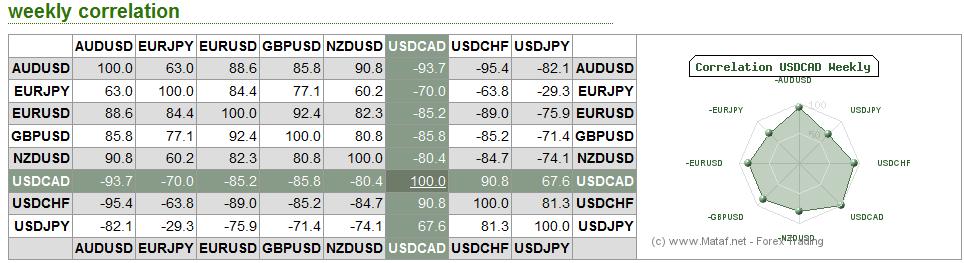
As it turns out, the forex markets are currently treating the Loonie and the Aussie as inseparable. According to Mataf.net, the AUD/USD and CAD/USD are trading with a 92.5% correlation, the second highest in forex (behind only the CHFUSD and AUDUSD). The fact that the two have been numerically correlated (see chart below) for the better part of 2011 can also be discerned with a cursory glance at the charts above.

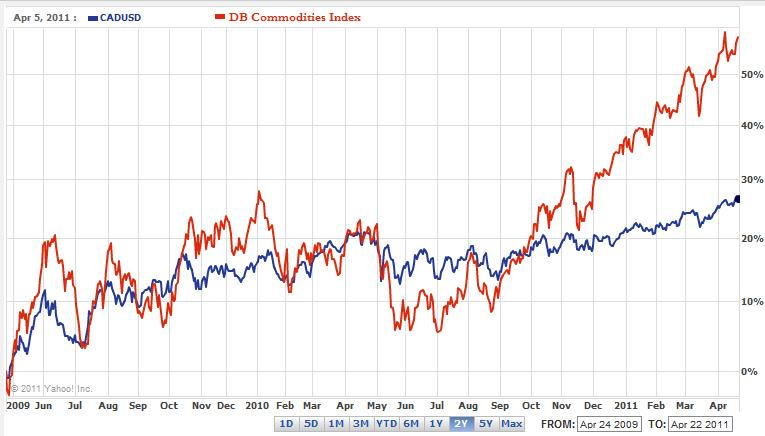
Why is this the case? As it turns out, there are a handful of reasons. First of all, both have earned the dubious characterization of “commodity currency,” which basically means that a rise in commodity prices is matched by a proportionate appreciation in the Aussie and Loonie, relative to the US dollar. You can see from the chart above that the year-long commodities boom and sudden drop corresponded with similar movement in commodity currencies. Likewise, yesterday’s rally coincided with the biggest one-day rise in the Canadian Dollar in the year-to-date.
Beyond this, both currencies are seen as attractive proxies for risk. Even though the chaos in the eurozone has very little actual connection to the Loonie and Aussie (which are fiscally sound, geographically distinct, and economically insulated from the crisis), the two currencies have recently taken their cues from political developments in Greece, of all things. Given the heightened sensitivity to risk that has arisen both from the sovereign debt crisis and global economic slowdown, it’s no surprise that investors have responded cautiously by unwinding bets on the Canadian dollar.

Finally, the Bank of Canada is in a very similar position to the Reserve Bank of Australia (RBA). Both central banks embarked on a cycle of monetary tightening in 2010, only to suspend rate hikes in 2011, due to uncertainty over near-term growth prospects. While GDP growth has indeed moderated in both countries, price inflation has not. In fact, the most recent reading of Canadian CPI was 3.7%, which is well above the BOC’s comfort zone. Further complicating the picture is the fact that the Loonie is near a record high, and the BOC remains wary of further stoking the fires of appreciation by making it more attractive to carry traders.
In the near-term, then, the prospects for further appreciation are not good. The currency’s rise was so solid in 2009-2010 that it now seems the forex markets may have gotten ahead of themselves. A pullback towards parity – and beyond – seems like the only realistic possibility. If/when the global economy stabilizes, central banks resume heightening, and risk appetite increases, you can be sure that the Loonie (and the Aussie) will pick up where they left off.

Wednesday, June 8, 2011

Currency Correlations, Part II: Canadian Dollar Begins its Decline

Currency Correlations, Part II: Canadian Dollar Begins its Decline
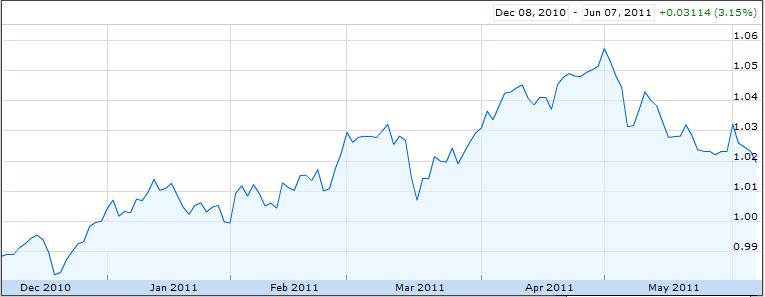
In April, I wrote a post entitled, “Economic Theory Implies Canadian Dollar will Fall,” in which I argued that the currency’s impressive rise was belied by fundamentals. It seems the gods of forex read that post; since then, the Loonie has fallen 3% against the US dollar alone. Based on my reading of the tea leaves, the loonie will fall further over the coming months, and finish the year below parity.


My contention is basically that investors are falsely treating the Loonie is a high-yield growth currency, and hence, bidding up its value. There are a few reasons why I believe this viewpoint is completely erroneous. First of all, Canada’s economy is both plain and mature. While it is indeed rich in natural resources would seem to make it stand-out, commodities exports account for only a small portion of GDP. Given that the US absorbs 75% of its exports, it’s no accident that Canada’s economic fortunes are tied closely to the US. Finally, Canadian interest rates are pretty mediocre, which means there is neither a strong monetary nor an economic impetus for buying the Loonie against the dollar.
While Canadian GDP and inflation have exceeded analysts’ predictions, the consensus expectation is still for the Bank of Canada to hold off on tightening until September or so. Even the most bullish forecasts show a benchmark interest rate of only 1.75% by the end of 2011 and perhaps 3% at the end of 2012. In other words, it will be a long time before the Loonie becomes a viable target currency for the carry trade.
According to OECD models, the Canadian dollar is overvalued by 17% against the Dollar on a purchasing power parity (ppp). While it is generally dubious to apply this concept to currency markets, I think it’s reasonable to invoke it when analyzing the USD/CAD. The two economies share more than just a border. As I said, their economies are closely intertwined, and goods, services (and people!) move freely between the two. Thus, you would expect that large discrepancies in prices should disappear over the medium-term. In fact, the Canadian trade balance recently slipped into deficit for the first time in 40 years (corresponding with the Loonie’s record high level), which shows just how quickly consumers can shift their attention south of the border. That means that either Canadian prices have to decline (something which retailers are always reluctant to effect) or the Loonie must drop further against the Dollar.
Of course, there is a mitigating factor: the US dollar may fall even faster than the loonie. While it would seem impossible to tease apart the loonie’s rise from the dollar’s fall (since a rise in CADUSD inherently reflects both), we can still make an educated guess. For example, consider that the Canadian dollar is strongly correlated (i.e. greater than 80 or less than -80 in the chart above) with almost every other major currency, relative to the US dollar. If the correlation was low, than it would imply that the Canadian dollar is fluctuating (in this case falling) for endemic reasons. In this case, however, the almost perfect correlation with the majors shows that it is almost definitely a US dollar spike rather than a Canadian dollar correction.
Whether this trend continues then, depends more on the health of the US dollar and less on what investors think about the loonie.

Monday, April 25, 2011

Economic Theory Implies Canadian Dollar will Fall

Economic Theory Implies Canadian Dollar will Fall
Sometimes I wonder if I’m living in the clouds. All of my recent reports on the Canadian dollar were twinged with pessimism, and I argued that it would only be a matter of time before reality caught up with theory. While the continued surge in commodities prices has confounded everyone’s expectations, other economic trends continue to work against Canada. In other words, I think that there is still a strong argument to be made for shorting the loonie.


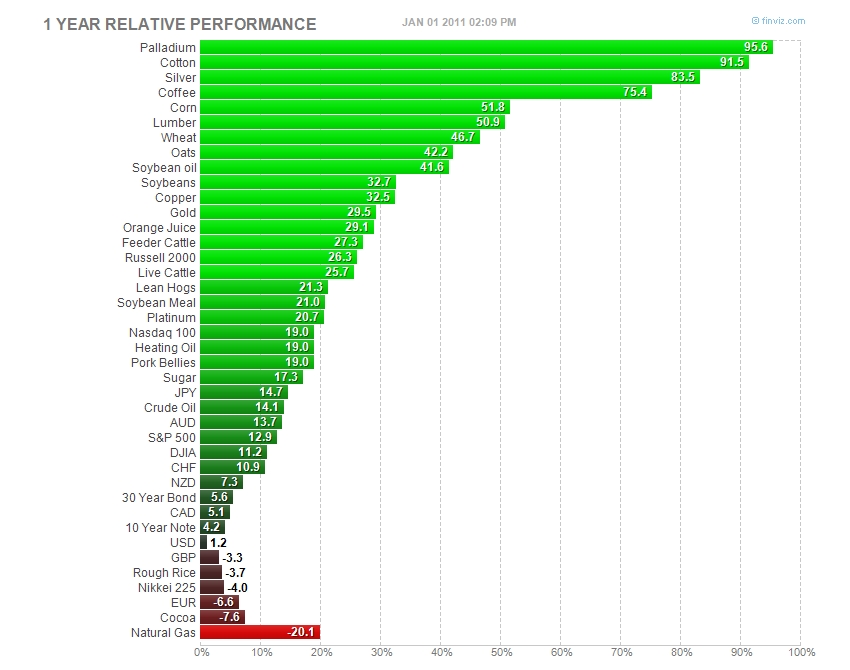
To be sure, the rally in commodities prices has been incredible- nearly 50% in less than a year! Oil prices are surging, gold prices just touched a record high, and a string of natural disasters have driven prices for agricultural staples to stratospheric levels. Given the perception of the Canadian dollar as a commodity currency, then, it’s no wonder that rising commodity prices have translated into a stronger currency.
As I’ve argued previously, rising commodities prices are basically an irrelevant – or even distracting – factor when it comes to analyzing the loonie. That’s because, contrary to popular belief, commodities represent an almost negligible component of Canada’s economy. Canadian exports, of which commodities probably account for half, have recovered from the recession lows of 2009. On the other hand, the value of Canadian exports is basically the same as it was 10 years ago, when one US dollar could be exchanged for 1.5 Canadian dollars.
Consider also that Canada now imports more than it exports, and that the Canadian balance of trade recently dipped into deficit for the first time since records started being kept 40 years ago. Its current account has similarly plunged, as Canadians have had to finance this through loans and investment capital from abroad. Based on the expenditure approach to GDP, trade actually detracts from Canadian GDP. Any way you perform the calculations, commodities are hardly the backbone of its economy, account for about 15% at most.
As if that weren’t enough, the press is full of stories of Canadians that think their own currency is overvalued. Businesses complain that they can’t compete, and that banks won’t lend them the money they need to upgrade their facilities and become more efficient. Meanwhile consumers whine about higher prices in Canada, compared to the US. I think it’s very telling that there is now a 2-hour wait to cross the border from Vancouver, and shopping malls on the American side have reported a huge jump in business. Even the famous Big Mac Index shows that the price of a hamburger was already 12% higher in Canada back when the loonie was still hovering around parity with the US Dollar.
One area that higher commodities prices will be felt is inflation, which is nearing a two-year high and rising. At 3.3%, Canada’s CPI rate is now higher than in the EU. Given that the European Central Bank hiked rates earlier this month, it probably won’t be long before the Bank of Canada follows suit. In fact, forecasters expect the benchmark rate to rise by 50-75 basis points by the end of the year, from the current 1%.
This might excite carry traders, but probably few others. Besides, given that other central banks will probably raise rates concurrently, it can’t be assumed that carry traders will automatically gravitate towards the Canadian dollar. Not to mention that as I pointed out in my previous post, the carry trade is hardly a risk-free proposition. In this case, an interest rate differential of only 1-2% probably isn’t enough to compensate for the risk of a correction in the USD/CAD.
And that is exactly what I expect will happen. The fact that the loonie has shattered even the most optimistic forecasts is not cause for bullishness, but rather for concern. According to the most recent Commitment of Traders report, net long positions are reaching extreme levels, and it’s probably only a matter of time before the loonie returns to earth.

Saturday, January 8, 2011

Varied Forecasts for Canadian Dollar in 2011

Varied Forecasts for Canadian Dollar in 2011
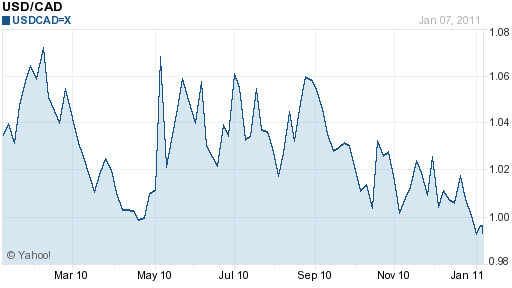
The Canadian Dollar (“Loonie”) recorded a fairly strong 2010. It appreciated 5.5% against the US Dollar, as an encore to a 16% gain in 2009. Moreover, its rise occurred with remarkably little volatility, fluctuating within a tight range of $0.99 – $1.08 (CAD/USD. It total, it rose against “seven of its major peers,” and “gained 4.4 percent over the past year in a measure of 10 developed-nation currencies, Bloomberg Correlation-Weighted Currency Indexes showed.” As for 2011, it is expected to continue trading close to 1:1 against the USD, though analysts differ over which side of parity it will tend towards.


At the moment, there are a few key fundamental trends driving the Loonie. As the WSJ encapsulated, the first factor is investor risk tolerance: “The fortunes of the risk-sensitive Canadian dollar in 2011 will be determined in large part by the issues driving global market fluctuations.”  Due primarily to the EU sovereign debt crisis, risk appetite continues to experience dramatic ebbs and flows. Based on conventional wisdom, risk averse investors should incline towards shunning the Loonie in favor of the US Dollar and other safe haven currencies. However, if you track the Loonie’s actual performance, you can see that concerns over global financial instability have hardly impacted it. Thus, bulls see this uncertainty as a force that “pushes investors to diversify their foreign exchange holdings by picking up some Canadian dollars.”
The second set of factors are macroeconomic. While slowing slightly in the second half of the year, the Canadian economy nonetheless exhibited a solid performance, which is expected to continue into 2011. Goldman Sachs, for example, “now sees growth accelerating to 3.3 per cent in the second quarter of this year, and 3.5 per cent in both the third and fourth quarters amid improving domestic demand.” However, the strong performance by natural resources and Canadian export strength that drove growth in 2010 could also be interpreted as a wild card in 2011, as the trade surplus narrows from a moderation in commodities prices and an expensive Canadian Dollar.
Finally, there is the continuing search for “value currencies” that is driving investors towards the Loonie. According to Bill Gross, manager of the world’s biggest bond fund, “It’s a critical strategy going forward to get…into some currency that holds its value…I’d suggest Mexico, Brazil or Canada as three examples of countries with good fiscal balance sheets.” It doesn’t hurt that the Bank of Canada was the first G7 central bank to raise interest rates, and that its benchmark interest rate compares favorably with the US Dollar, Yen, etc. Moreover, it is forecast to hike rates by an additional 50 basis points in 2011, beginning in the third quarter. On the other hand, it will still be a couple years before rates are high enough to make carry trading viable. Besides, long-term interest rates are currently higher in the US, which means that investors hungry for yield will ultimately have to find other reasons for shifting funds to Canada.
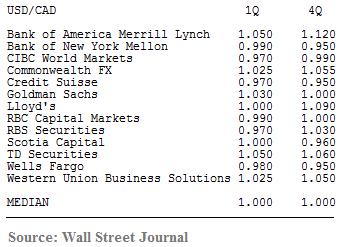
Forecasts for the Canadian Dollar in 2011 are extremely varied. If there’s any consensus, it is that barring any unforeseen developments, the Loonie will spend the year close to parity with the US Dollar. A couple analysts expect a big (downside) move, but the majority expects that regardless of which way the Loonie ultimately trends, it probably won’t be far removed from current levels. “The Bloomberg composite of 32 forecasts has the loonie spending most of the year at parity, then dipping slightly by the fourth quarter.” A similar WSJ survey shows a median forecast of 1:1 throughout the entire year.

Some analysts expect more movement in the currency crosses (i.e. against currencies besides the US Dollar). Given that the Canadian Dollar accounts for such a small portion of overall forex trading volume, however, it seems more likely that CAD cross rates will take their cues entirely from the USD and the rule of triangular arbitrage. (For example, if the Dollar rises against the Loonie but falls against the Aussie in 2011, the Loonie will necessarily also fall against the Aussie, regardless of whether fundamentals dictate such a movie).
I’m personally inclined to agree with the majority. There are many good reasons to buy the Loonie, but most of these were already priced in during the Loonie’s steady climb over the last two years. Going forward, I think that the US economy represents a double-edged sword that will prevent the Loonie from rising further. In short, if the US economy falters, so will the Canadian economy. If the US economic recovery gathers momentum, however, there will be good reason to buy the US Dollar in lieu of its counterpart to the north.